


-
MENU










Why Japanese Heavy Haulers Prefer Chain Lever Hoists Over Chain Binders
If you've spent any time watching heavy haul videos from Japan, you've probably noticed something unusual. Instead of using the familiar ratcheting chain binders (also known as load binders) that dominate North American heavy hauling, Japanese operators often reach for a completely different tool—a manual chain lever hoist, commonly called a lever block.
At first glance, it seems like an odd choice. After all, lever hoists are designed for lifting and pulling, not necessarily for securing cargo. Yet throughout Japan, they have become the preferred method for tightening transport chains on excavators, bulldozers, cranes, and other heavy machinery.
So why the difference?
The answer comes down to precision, control, and a different philosophy of load securement.

The American Method: Load Binders aka Chain Binders
Across the United States and Canada, chain binders are the industry standard.
Once Grade 70, Grade 80, or Grade 100 chain is attached to the trailer and machine, the binder shortens the chain and applies tension.
Ratchet binders are especially popular today because they're safer to release and allow gradual tightening. For most American heavy haul applications, they're quick, durable, and purpose-built for cargo securement.
The Japanese Method: Chain Lever Hoists
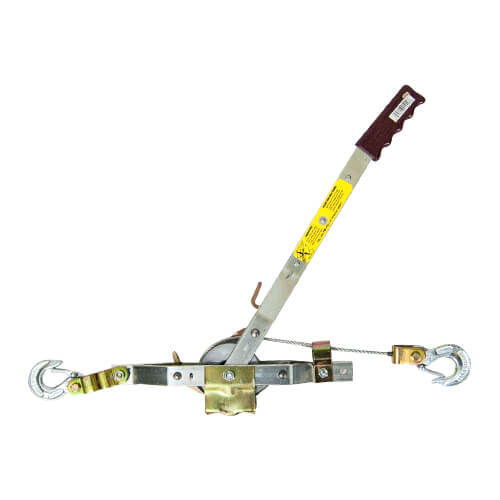
Japanese heavy haul operators often use compact manual lever hoists instead.
Rather than inserting a load binder into the chain, the operator hooks the lever hoist between two points in the transport chain and pumps the handle until the desired tension is reached.
The excess chain is then secured neatly.
To someone accustomed to North American trucking, it almost looks like they're using lifting equipment for tie-downs.
In reality, they're taking advantage of several characteristics that make lever hoists extremely effective.
1. Much More Precise Tension
A ratchet binder advances one click at a time.
A lever hoist uses a geared mechanism that allows the operator to apply tension very gradually with excellent mechanical advantage.
This gives the operator remarkable control over exactly how tight each chain becomes.
When transporting expensive hydraulic excavators, pavers, or specialized construction equipment, that consistency matters.
2. Higher Mechanical Advantage
Lever hoists typically provide a greater mechanical advantage than standard chain binders.
The operator can generate very high chain tension with relatively little physical effort.
This is especially useful when securing machines with suspension movement, rubber pads, or tracks that may settle slightly after loading.
3. Better Fine-Tuning
Heavy machinery rarely sits perfectly on a trailer.
One corner may need a little more tension than another.
With a lever hoist, operators can make tiny adjustments without releasing large amounts of tension first.
This makes balancing securement easier.
4. Built for Precision Work
Japanese construction culture places enormous emphasis on careful preparation and attention to detail.
- Equipment is often cleaned before transport.
- Chains are laid out neatly.
- Loose chain is tied back.
- Securement is inspected multiple times.
Using a lever hoist fits naturally into that philosophy—it prioritizes precision over speed.

Why Isn't This Common in America?
The biggest reason is tradition.
North American cargo securement standards evolved around dedicated transport binders, and regulations, training, and trucking culture all support their use.
Load binders are also:
- Faster to install.
- Less expensive.
- Specifically marketed for cargo securement.
- Familiar to every heavy haul driver.
For fleets moving dozens of loads each week, speed and standardization are major advantages.
Which Method Is Better?
Neither method is universally better.
Each reflects decades of industry development.
- American trucking emphasizes speed, ruggedness, and standardized cargo securement equipment.
- Japanese heavy hauling emphasizes precision, controlled tensioning, and meticulous load preparation.
Both methods, when used correctly with properly rated equipment and in compliance with local regulations, can safely secure heavy machinery.
The interesting part isn't that one country is "right" and the other is "wrong."
It's that two highly experienced heavy haul industries arrived at different solutions to accomplish exactly the same goal: transporting thousands of pounds of machinery safely from one job site to the next.
- Choosing a selection results in a full page refresh.